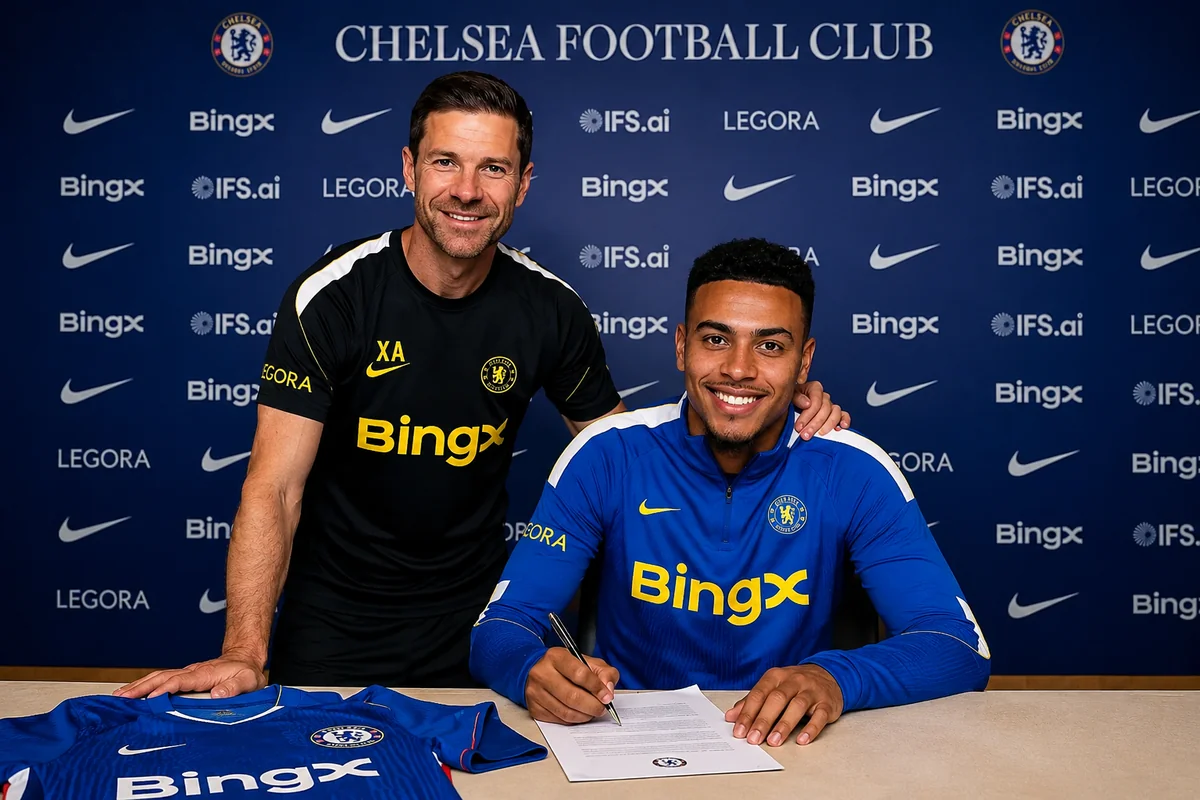
Chelsea have stunned the transfer market by prising England midfielder Morgan Rogers away from Aston Villa for a British-record £117m. It is a signing few saw coming — so how did the Blues pull it off in under 48 hours, and what does it mean for Xabi Alonso's rebuild?
Key takeaways
- Rogers joins for a British-record £117m on a six-year deal, with the option of a further year.
- Chelsea moved within 48 hours of England's World Cup exit, beating out favourites Arsenal.
- Alonso is weighing a back three that could field Rogers and Cole Palmer as dual No.10s.
- A major sell-off looms as Chelsea trim a bloated 37-man senior squad to balance the books.
Chelsea have completed the signing of Morgan Rogers from Aston Villa for a British-record fee of £117m. The England international flew back from the United States after his World Cup campaign, passed a medical in London and put pen to a six-year contract with the option of an additional season.
"I'm joining the biggest club in London," Rogers said in his unveiling video. "The way the club wants to move forward is something I want to be a part of. It was just perfect for me — I can't wait to get going."
The 48-hour raid that caught everyone out
Rogers was Villa's crown jewel, and the assumption across the game was that only an English-record fee would test their resolve — with Arsenal widely tipped as favourites. Chelsea, though, had been quietly tracking him for over two years and had privately made him their number-one attacking target.
They struck the moment England's tournament ended. After the Three Lions' 2-1 semi-final defeat by Argentina, a coordinated push involving Chelsea's sporting directors, head coach Xabi Alonso and co-owner Behdad Eghbali got the deal moving. Captain Reece James was reportedly talking the club up from inside the England camp, while — in Rogers' words — "one of my best friends in life," Cole Palmer, was kept in the loop throughout.
"You need to add more ready-made players at this part of the project, to take it to the next level and be consistent over time. You tweak a model, you improve, you learn from mistakes."
— Behdad Eghbali, Chelsea co-owner
The agreement — underpinned by the strong relationship between Eghbali and Villa owner Nassef Sawiris — was sealed on Saturday afternoon, just before Rogers featured in England's bronze-medal win over France. Arsenal were then handed the chance to match the bid, but told Villa they would not move beyond their lower valuation and were content to let him go. The Gunners now turn to alternatives such as PSG's Bradley Barcola and Bournemouth's Junior Kroupi.
Reunited with Palmer — and a familiar dressing room
Rogers walks into a Stamford Bridge squad full of familiar faces. His friendship with Palmer stretches back to their teenage years at Manchester City, where the pair — both 16 at the time — starred in the FA Youth Cup-winning under-18 side of 2020. That bond even inspired Palmer's celebrated "cold" celebration, which he first performed as a nod to Rogers before making it his own and trademarking it.
Beyond Palmer, Rogers already knows Levi Colwill and Reece James from the England set-up, while Tosin Adarabioyo, Jamie Gittens, Romeo Lavia and Liam Delap are all fellow City academy graduates — an English core that, alongside Enzo Fernández and Moisés Caicedo, forms the spine of the club's leadership group.
Where does Rogers fit for Alonso?
The intriguing question is tactical, given how closely Rogers' profile mirrors Palmer's. Thomas Tuchel picked Rogers ahead of Palmer at the World Cup, but their versatility means they can line up together or cover for one another. One source suggests Rogers will operate mainly on the left, with Palmer central as a No.10, leaving Estêvão Willian, Pedro Neto and new arrival Geovany Quenda to contest the right flank and Gittens as back-up.
Alonso is expected to use a back four at times, but is also exploring the back three that carried his Bayer Leverkusen to the 2024 Bundesliga title. That shape could unleash Palmer and Rogers as twin playmakers, with the wide men dropping into wing-back roles. After a season that included a five-game goalless drought under the since-sacked Liam Rosenior, Rogers' output — 14 goals and 12 assists in 55 appearances — should add badly needed cutting edge.
The catch: Chelsea must sell, and sell big
This kind of spending does not happen in isolation. The £117m outlay sits on top of the £47m paid for full-back Marco Palestra, plus the anticipated arrivals of defenders Pep Chavarría and Maxence Lacroix and midfielder Valentín Barco. To satisfy the Premier League's financial rules — shifting this summer from an FFP model to a squad-cost-ratio system — Chelsea offloaded a league-record £300m of players last season, and the pressure has not eased.
By the numbers
- £117m — British-record fee for Rogers.
- 37 senior players currently on the books; at least a dozen expected to leave.
- £120m+ already banked from selling Cucurella, Santos, George and Morgan.
- £2.6m — this summer's reduced UEFA fine, down from £26.7m a year ago.
UEFA remains the sternest watchdog: Chelsea were fined £26.7m last summer and breached the rules again this year, though a much-improved financial picture cut the latest penalty to just £2.6m — most of which will be waived if progress continues. With around five signings incoming, at least a dozen of the 37 senior players will need to be sold or loaned out. Marc Cucurella (Real Madrid), Andrey Santos (Manchester United), Tyrique George (Everton) and Jimmy-Jay Morgan (West Brom) have already gone for a combined £120m-plus, and — assuming Alejandro Garnacho follows as planned — a crowded forward line and five senior strikers underline just how much trimming lies ahead for a club that finished 10th last term.