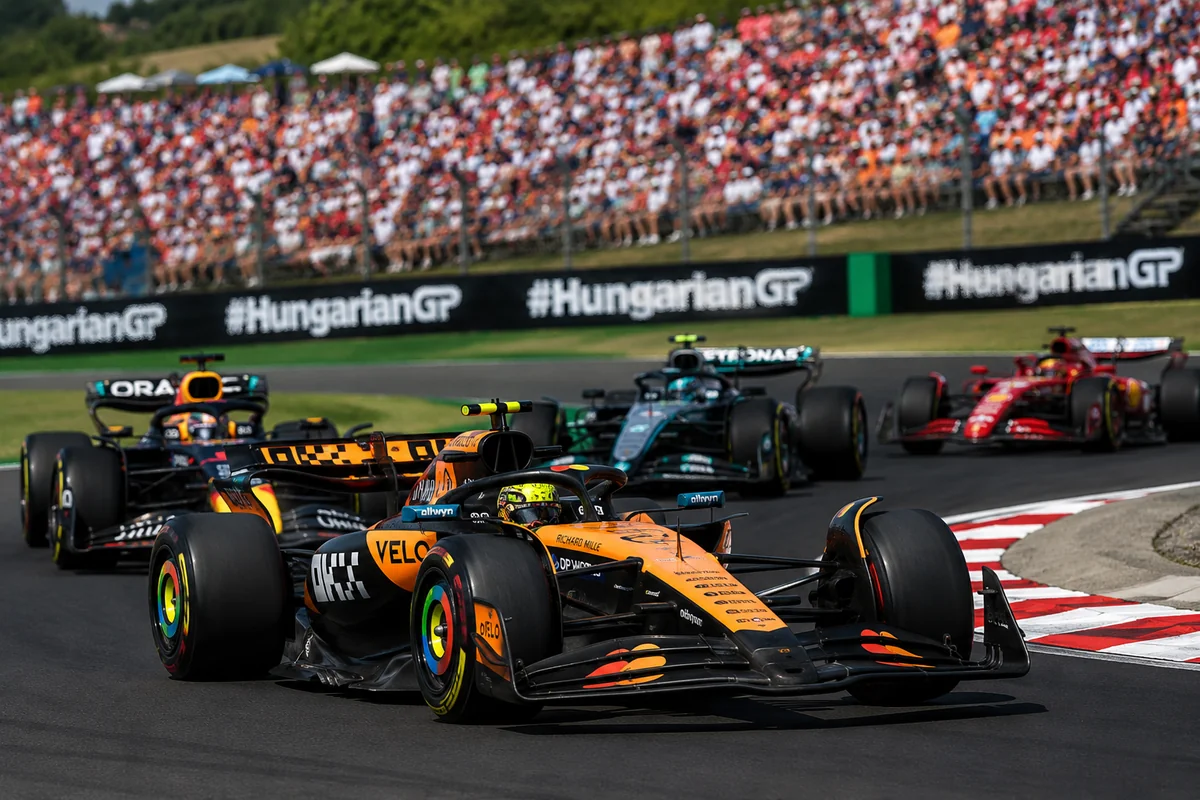
Three drivers stood on the Hungaroring rostrum on Sunday, and between them they told the whole story of modern Formula 1: the champion of last year, the champion of the era just gone, and the man who looks increasingly likely to be champion of this one. At the exact midpoint of the 2026 season, Budapest offered a snapshot of everything the campaign has been.
Key takeaways
- Lando Norris took his first win of his title defence, ahead of Max Verstappen and Kimi Antonelli.
- Oscar Piastri led early, was hit by a lapped Carlos Sainz, then retired with a gearbox failure.
- Antonelli heads into the summer break 50 points clear of Lewis Hamilton and 59 clear of George Russell.
- Ferrari arrived as favourites and left with a handful of points after a strategy that misfired.
Reigning world champion Lando Norris finally opened his account for the season with a win that felt like a statement rather than a relief. Behind him came four-time champion Max Verstappen, whose second place for Red Bull nobody had on their card, and runaway points leader Kimi Antonelli in third. All three earned their place on that podium.
Around them, the two stories that have defined 2026 played out again. Ferrari, who looked untouchable heading into qualifying, evaporated on Sunday. And George Russell — once the favourite for this title — suffered yet another weekend of things going wrong that had nothing to do with him.
McLaren, and a race that felt like 2025 all over again
Norris has spent much of this season looking like a man fighting his own car. The MCL began the year unreliable, and McLaren have not always extracted everything from their Mercedes power unit. Defending a first world championship in those circumstances has been an uphill job.
Sunday, though, had the texture of last season. Piastri jumped into an early lead, the two papaya cars scrapped hard in the middle stint, and then things quietly unravelled for the Australian as his team-mate grew into the race. There was even a flashback to the Papaya Rules era: on lap 32, Norris asked to be brought in ahead of the race-leading Piastri, and was told no.
"You mean you won't let me? I'm miles faster. I'll pull out a 10-second gap in no time."
— Lando Norris, over team radio on lap 32
Piastri did get the better end of the strategy as the lead car, stopping first — but he emerged into traffic. Carlos Sainz, locked in a scrap with Fernando Alonso's Aston Martin, never saw the McLaren arriving and drove into its flank. The contact was glancing enough not to end anyone's race, but it cost Piastri time he could not afford.
His verdict afterwards was blunt. Being hit by a lapped car, he said, is not something a driver plans for, and the fact that nobody warned Sainz he was coming amounted to a complete failure of awareness. He went further, noting that Sainz has been quick to criticise others in the past and might benefit from a look in the mirror after fighting Alonso for last place "like it was the world championship."
In fairness, the numbers do not fully back the grievance. Piastri came out of the pits 0.7 seconds behind Norris — a gap the contact and the extra corners spent clearing Sainz could plausibly account for on their own. The lead had already gone.
What happened next settled the argument anyway. Before the stops, Piastri had been unable to shake Norris. Once the positions reversed, the gap opened immediately and kept growing. Norris seemed intent on proving his point, to the extent that on lap 53 his engineer Will Joseph asked him to calm down and stop locking up at Turn 1. A lap later the message was less diplomatic: he was clearly the quickest car out there and had nothing left to prove, so the snaps at Turns 4 and 8 needed to stop.
A few laps after that, Piastri's gearbox failed with the deficit already at 13 seconds. Norris admitted afterwards that part of him still wanted to grab the fastest lap on the final tour — but that he knew Joseph would shoot him for it, so he behaved.
Verstappen and Antonelli, both surprised to be there
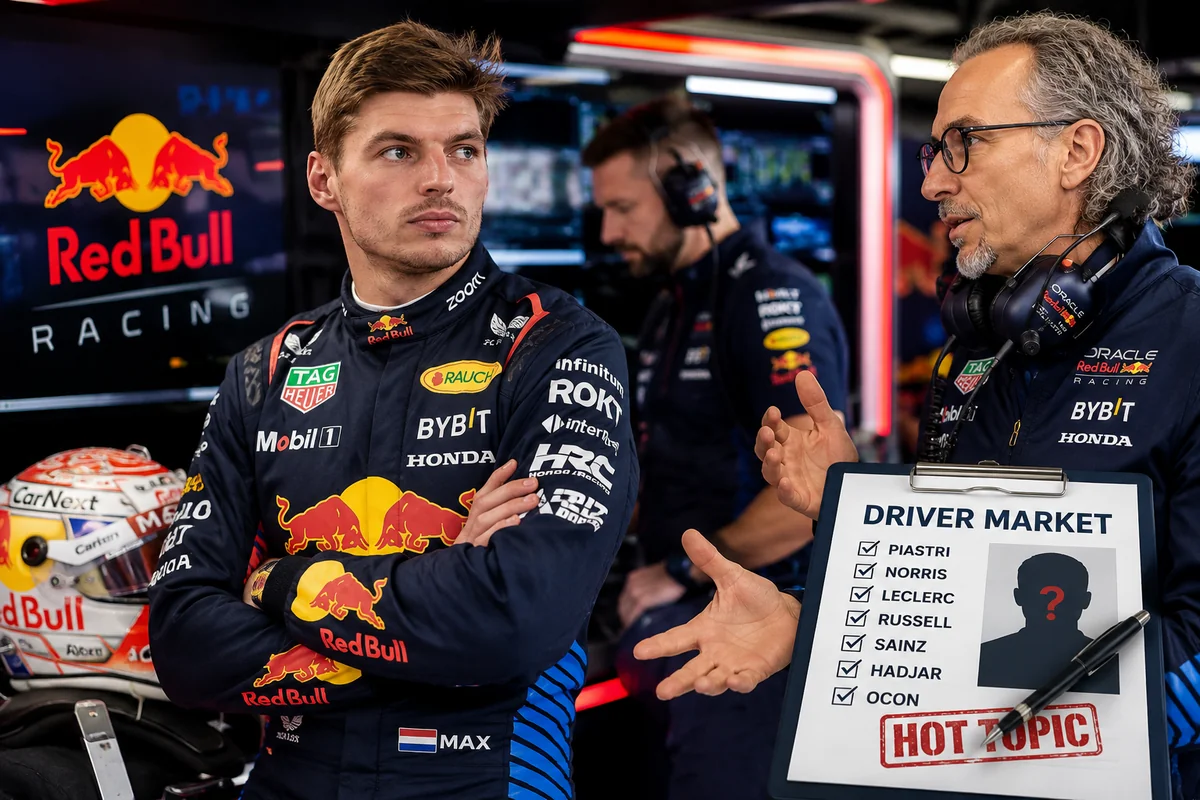
Neither man who joined Norris on the podium seemed to have expected it. Verstappen, still grinning about it long after the flag, said his overriding thought had been wondering how on earth he had ended up there — and that he remained genuinely shocked.
That reaction made sense. He had been furious after qualifying, describing the way his Red Bull fell away in performance as "a joke." Even with grid penalties for Antonelli and Lewis Hamilton handing him track position, a podium looked fanciful when the field lined up.
The race said otherwise, and one moment defined it: the lap-16 pass on Hamilton. Verstappen had dropped behind his old 2021 rival after the first stops, and given Ferrari's practice pace, the expectation was that the red car would simply drive away. Instead Verstappen threw it down the inside at Turn 1 in a move that will take some beating for overtake of the year.
His own description was typically flat — he knew it was his only chance, the Ferrari's pace was not bad, so he took the opportunity when it appeared. His race engineer Gianpiero Lambiase put it rather better in the moment: "Well, that was quite special."
It was a useful reminder, too. Verstappen has made no secret of his dislike for this generation of machinery — he said earlier in the week he is "fed up" with even complaining about cars he has branded "anti-racing" and likened to Mario Kart. Give him half an opening, though, and he still races them like the finest overtaker of his generation.
By the numbers
- 1st — Norris' first victory of his championship defence.
- Lap 16 — Verstappen's Turn 1 pass on Hamilton, an early contender for move of the year.
- 50 points — Antonelli's advantage over Hamilton going into the break.
- 13 seconds — Piastri's deficit to Norris when his gearbox let go.
Antonelli's third place sends him into the shutdown 50 points clear of Hamilton and 59 ahead of Russell. Plenty of racing remains, but that is a commanding cushion for a driver who has been startlingly fast for most of the year. Asked to rank the season's standout performers, he declined to judge — allowing only that he felt he had put together a good first half, that comparing drivers across different cars is close to impossible, and that he still has a long way to go before reaching the level of the two men who shared the podium with him.
Spare a thought, meanwhile, for the man most people installed as title favourite before a wheel turned. Russell's stock only rose after victory in Australia, but he has since been comprehensively out-driven by his own team-mate — and has a decent claim to being the unluckiest driver on the grid. A water leak wrecked his qualifying on Saturday; on Sunday, anti-stall triggered off the line and dumped him at the back.
His response was the same brave face he has been forced to wear all year: he is staying positive because he has already spent enough of the season being disappointed, he accepts much of what has gone wrong is outside his control, and there are things within it he intends to improve. He was clear, though, that he is not happy with how any of it has gone.
Ferrari's weekend falls apart
Toto Wolff summed up the Scuderia's Sunday with a line that will sting in Maranello: Hamilton had this race won on Friday and Saturday morning, he said, and Mercedes came away from it having gained a few points.
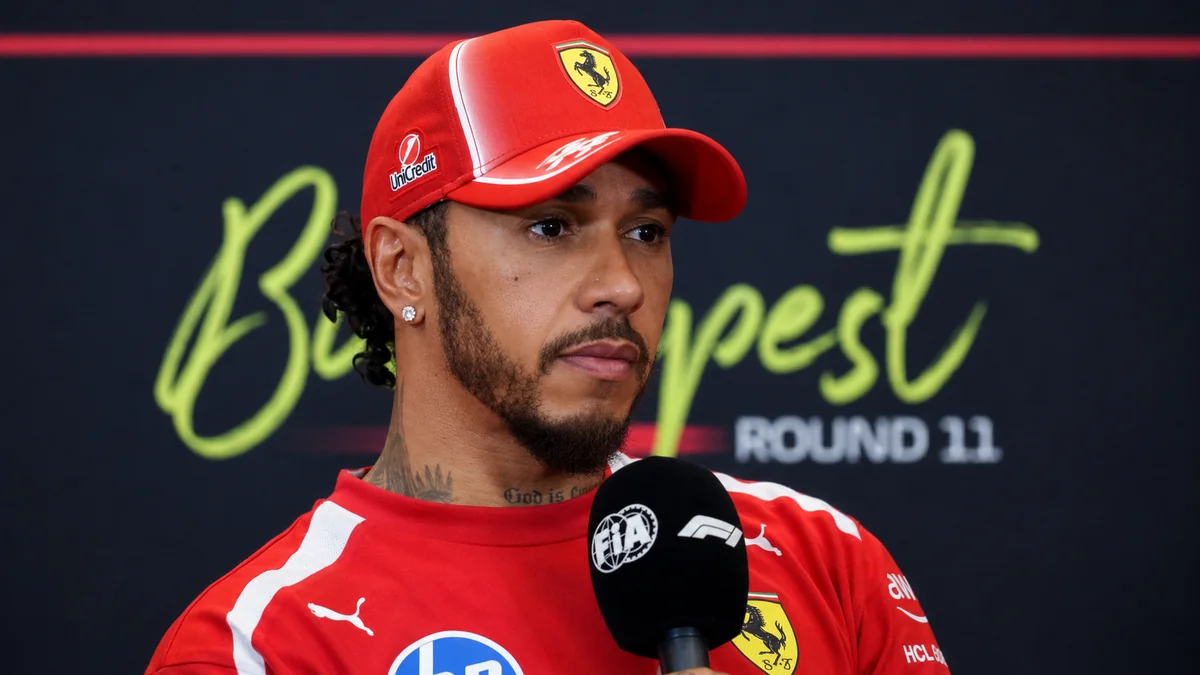
The Hungaroring was supposed to be the circuit where Ferrari's superior chassis tilted things back in their favour and hid the power deficit they have carried against Mercedes all season. Their crushing practice form thinned out in qualifying and then vanished altogether in the race. Hamilton's own assessment was short: pretty bad, pretty frustrating.
Ferrari had reason to feel doubly confident, having saved an extra set of softs for both drivers. Hamilton and Charles Leclerc both started on the softer rubber, which in theory promised more grip and a livelier car. Leclerc was unconvinced afterwards that leading into Turn 1 would have transformed the afternoon — the scenario was so far removed from the race he actually had that he struggled to picture it, though he conceded it would obviously have helped.
What compounds the frustration is that this was another weekend where the team fell short across the board. A breakdown in communication between Hamilton and the pit wall contributed to a three-place grid penalty for impeding Piastri in qualifying. Hamilton then collected a five-second penalty late on for a marginal pit-lane speeding infringement.
The stop itself baffled him. He said he was told to come in immediately before the pit entry, leaving no time to argue, and that he would never have stopped had he known it meant surrendering track position — which he had assumed it would not. His reading is that Verstappen, on fresher tyres, would probably have taken second from him in the final stint anyway, but that third was there for the taking and a far better outcome than what he ended up with.
It carried an unwelcome echo of the Ferrari of recent years, the one that repeatedly got the big strategic calls wrong. Team principal Fred Vasseur did not hide from it: Red Bull's strategy was never on their radar because they had stopped slightly earlier than Verstappen, and going to the end without accounting for tyre life looked too ambitious. Without a proper long run on all three compounds in practice, they gambled twice — and, as he put it, neither bet paid off.
Perhaps Hamilton's win in Spain and Leclerc's in Britain gave them the confidence to gamble. Ferrari have undeniably improved this year, but this was a deflating way to reach the recess.
Hamilton still sits second in the drivers' standings, Ferrari second among the constructors. Attention now turns to how both emerge at Zandvoort and then at Monza. The seven-time champion, for his part, left on an upbeat note: given that he reckons Ferrari have been three or four tenths down on straight-line pace and power all year, he called it an impressive first half. Upgrades have arrived weekend after weekend, more are coming, and he believes the second half will be stronger.
Anyone hoping this championship runs deep into the autumn will be counting on him being right.