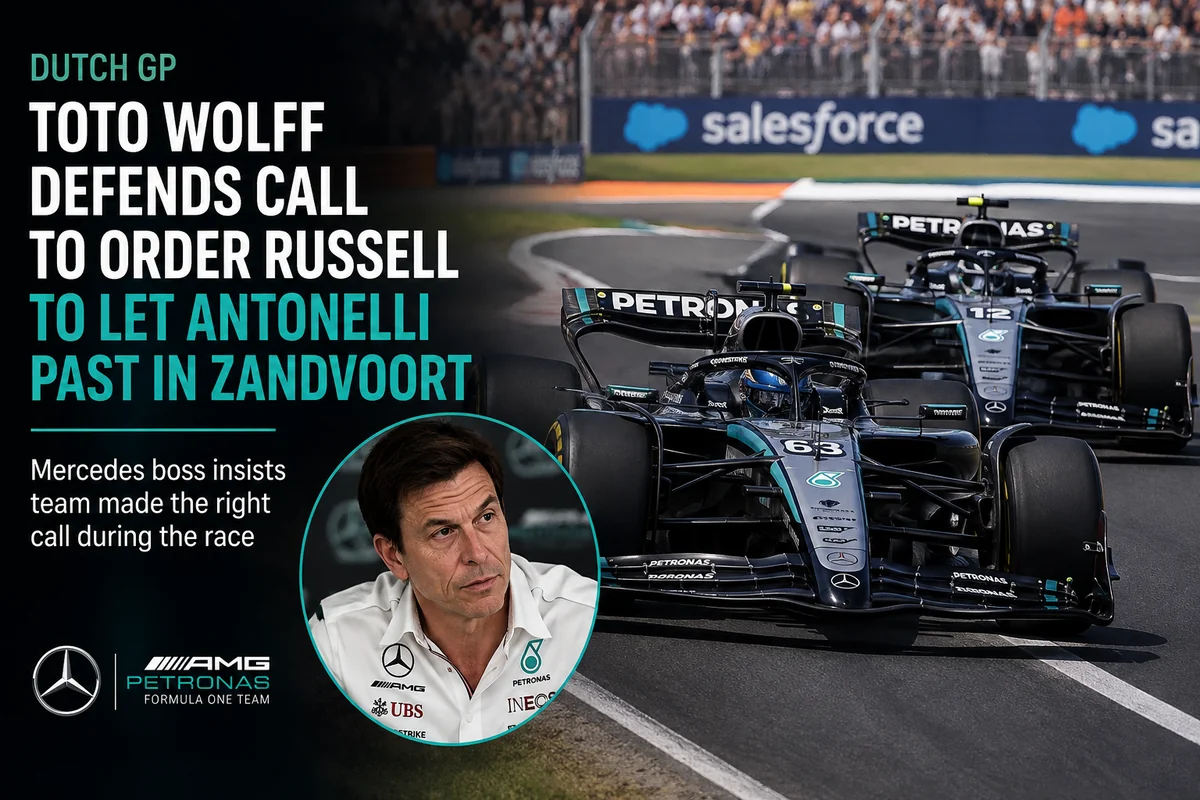
Sixteen laps from the end of the Dutch Grand Prix, Mercedes made the call that decides how a title season is remembered: they told George Russell to move aside for Kimi Antonelli. Russell obeyed, then spent the closing laps holding a charging Lewis Hamilton at arm's length to keep the podium. Toto Wolff's verdict on a decision that looked brutal from the outside? "Not a difficult" one.
Key takeaways
- Lando Norris won at Zandvoort; Antonelli took second, Russell third after a team order.
- Mercedes pitted Antonelli under a virtual safety car with 16 laps left, dropping him behind his own team-mate.
- Russell was asked to invert the cars — and was then exposed to Hamilton on fresh Ferrari tyres, with Leclerc in tow.
- Antonelli's championship lead over Russell grew to 59 points.
- Wolff: the swap was pre-agreed team policy and "would have been the other way around exactly the same".
The stop that created the problem
Antonelli was running second behind Norris when the virtual safety car appeared with 16 laps remaining. Mercedes took the cheap tyre change — the kind of stop that costs almost nothing in a neutralised race — and the Italian rejoined on fresh rubber in third, directly behind Russell.
On paper that was a free upgrade. In practice it created the exact scenario Zandvoort punishes: two cars from the same team, on wildly different tyre life, at a circuit where overtaking is closer to a negotiation than a manoeuvre. Antonelli closed onto Russell's gearbox within a couple of laps and then sat there, quicker but not obviously quick enough to get by.
It also became clear very fast that the fresh tyres were not going to buy a win. Norris had been managing the gap all afternoon and had pace in reserve. So the only thing genuinely at stake was the order of the two silver cars — and how much time they were willing to lose settling it while two Ferraris closed in.
Wolff: the call was made hours before the race
Mercedes chose not to let it play out. Russell was told over the radio to let Antonelli through into second — a decision that handed the championship leader six extra points and left Russell defending third on older tyres against Hamilton, who had a much fresher set and Charles Leclerc for company.
"That looks difficult on the outside but not on the inside. It's a situation we discussed very often, also today in the morning — we're not going to lose time fighting with each other and have two Ferraris breathing down our neck. It would have been the other way around exactly the same. It plays no role who is ahead in the championship or not, it's just about protecting the best possible positions."
— Toto Wolff, Mercedes team principal
That last line is the part worth holding onto. Wolff's argument is not that the title leader gets priority; it is that a team which has already agreed the rule before lights out never has to improvise under pressure. He was equally clear that Antonelli was never a realistic threat to Norris, and that leaving the two Mercedes to scrap over second with Overtake Mode deployed was a risk with no upside.
He also pushed back on the idea that a team principal's job is to manage feelings rather than results. "There's 2,500 people who work for championships, and it's not one man's game," he said, framing the swap as ordinary operating procedure at a team that has run this way for fifteen years — and taking an unmistakable swipe at rivals whose internal rules only seem to exist once the argument has already started.
Russell asked the question, then did the job
Russell's first response on the radio was not refusal but interrogation: was Antonelli actually going to catch Norris? Once the answer was no, he moved over without further debate — and then produced the best driving of his afternoon, absorbing Hamilton's pressure through the closing laps with a second VSC period helping to break the Ferrari's momentum.
"We've always said as a team, when we're on different strategies, we're never going to fight and we're always going to invert. Kimi was ahead of me before the VSC and he tried something different to protect us as a team. Could I have kept him behind? Maybe. But equally, it could have been a P5 as well. In the end, he deserved to be P2. I think P3 was a fair result for me."
— George Russell
The "it could have been a P5" line is the one that explains the whole decision. Two Mercedes squabbling over second at Zandvoort do not stay second and third for long when Hamilton and Leclerc are arriving with better tyres. Russell's read was that the alternative to losing one place was losing two.
Antonelli's awkward afternoon
For the championship leader it was a strange kind of good result. The 19-year-old had actually led the race after passing Norris at an early restart, only to find the McLaren untouchable once both cars switched to the hard compound at the first round of stops. His final stint before the VSC was a grind — low confidence, no rhythm, nothing to attack with.
He was also the first to admit that the strategy which rescued his afternoon put his team-mate in the firing line.
"George made my life a lot easier — I have to thank him. I still think I probably could have stayed out and gone to the end on the same set, because pitting put us a little bit at risk. I feel we put George at risk too, having to let me by. But it was a great team execution, and P2 was the maximum today, because the pace of the McLarens in the second half was just too strong."
— Kimi Antonelli
What it costs, what it buys
The numbers behind the call
- 16 — laps remaining when the VSC handed Mercedes the free stop.
- 6 — points transferred from Russell to Antonelli by the swap.
- 59 — the championship gap between the two Mercedes drivers after Zandvoort.
- 2 — Ferraris within striking distance of the podium in the closing laps.
- 15 — the number of years Wolff says the team has operated to these rules.
Six points is not nothing, and Russell has now surrendered them to the team-mate he is chasing. But a 59-point deficit is not the kind of margin that gets clawed back one podium place at a time, which is precisely why the order was easy to give and, evidently, easy enough to accept. The constructors' championship, meanwhile, cares only that both cars came home ahead of both Ferraris.
The more interesting test is still ahead. Mercedes' policy holds beautifully while the driver being asked to move is out of realistic title contention. It gets considerably harder to apply the day the gap is nine points rather than 59 — and Wolff's insistence that the swap "would have been the other way around exactly the same" is a promise the team will eventually be asked to honour in far less comfortable circumstances.
Next stop: Monza
Formula 1 now heads to Ferrari's home race, the Italian Grand Prix at Monza on September 4-6 — a weekend that will be complicated for the championship leader before it starts, with Antonelli already set to take a grid penalty for an engine change. A low-downforce circuit, a scarlet crowd, and a title favourite starting out of position: the calm of Zandvoort is unlikely to survive the trip.
The bottom line
Mercedes did the unglamorous, correct thing: they refused to let two of their own cars burn time on each other while Ferrari closed in, and they had agreed to do it before the race even started. Russell lost six points and gained a reputation as the most professional number two in the field; Antonelli banked a second place he did not really have the pace for; Wolff got the outcome he wanted without a public argument. The bill for all this arrives whenever the two Mercedes are genuinely fighting the same championship — and on Sunday's evidence, the team has at least written down what it will do when that day comes.