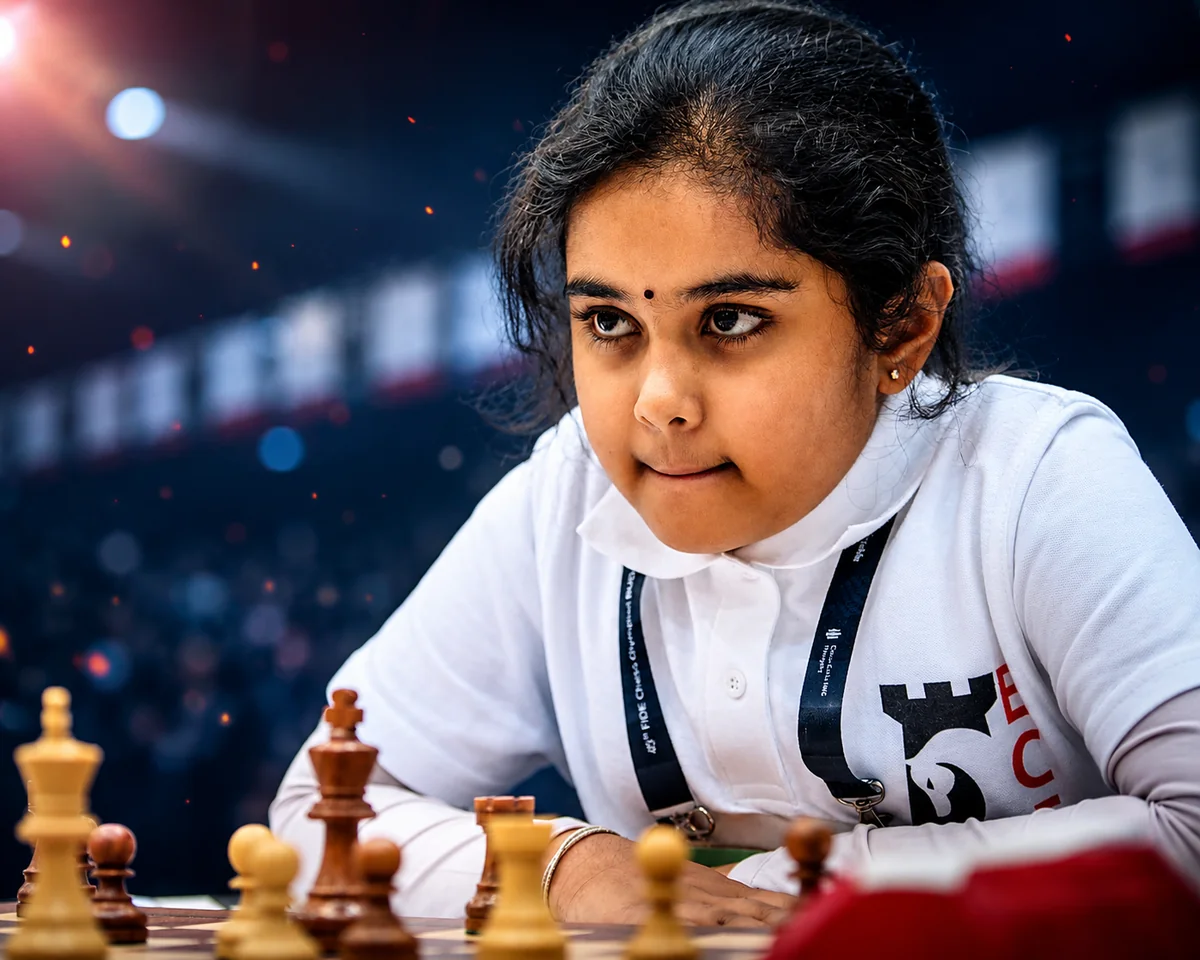
Bodhana Sivanandan is eleven, goes to school in Harrow, and has just done something no girl in the history of chess has done at her age. At the Dole Trophy in Aix-en-Provence she scored her first international master norm — erasing an age record that had belonged to Judit Polgar since 1988, and beating it by nearly five months.
Key takeaways
- Sivanandan is the youngest girl ever to score an IM norm, breaking Judit Polgar's record from April 1988.
- She performed at 2463 against a 2420-rated field — above the 2450 IM norm threshold.
- The same result also cleared 2400, delivering her second women's grandmaster norm.
- She beat reigning French champion Marc'Andria Maurizzi in round one, then dropped to 2/5 before a four-round surge.
- A third WGM norm before she turns 12 years and four months would take another age record, this one from Kateryna Lagno.
Records in junior chess arrive often enough that it is easy to become numb to them. This one deserves attention, because of who held it and how long it stood.
Judit Polgar — still, decades on, the strongest female player the game has produced — scored her first IM norm in April 1988, in the International B section of the New York Open, aged 11 years and nine months. That mark survived thirty-eight years. Sivanandan took it down last Saturday in the south of France, and she did not do it in a soft field.
A tournament that did not look like a record until it was one
The opening round could hardly have been better: a win over Marc'Andria Maurizzi, the reigning French champion. Then the tournament turned. Facing a field that included two more grandmasters and an international master, Sivanandan slid to 2 points from 5 — a score that puts a norm out of reach for almost everybody.
What followed was the part that actually explains the result. Over the last four rounds she produced the surge that dragged the performance rating back above the line, finishing with a ninth-round game that has already become the story of the event.
Six hours, 99 moves, last board standing
Her final opponent was Samrug Narayanan, a rising American international master. A queen's pawn opening turned into a grinding rook-and-minor-piece endgame in which the eleven-year-old spent most of the session defending. At one stage Narayanan had a win — difficult, but real — and did not find it.
The game ran to 99 moves and roughly six hours. Out of 150 boards in the hall, they were the last two players still sitting at one. The half point was enough.
The numbers behind the norm
- 2450 — minimum performance rating required for an IM norm.
- 2463 — Sivanandan's actual performance at Dole.
- 2420 — the average rating of the field she faced.
- 2400 — the WGM norm threshold, also cleared in the same event.
- Two certificates — the organisers duly issued both norms.
The Batumi puzzle: 300 points in a few weeks
The genuinely strange part of this story is where she was a few weeks earlier. At the European Women's Championship in Batumi, Georgia, Sivanandan performed below 2200. By her own father's account it was worse than the score suggests: she stood badly in nine of her eleven games, and still finished on 5.5/11 through a mixture of stubborn defence and opponents' errors.
Between Batumi and Dole her performance level jumped by close to 300 Fide points. And it happened during a stretch when, as her father Sivanandan Velayutham explained, her online coach was unavailable and she was busy with end-of-term school activities plus a French and a maths competition. Less chess work, not more.
Improvement in young talents tends to come in quantum jumps, followed by periods of consolidation and partial retracement — not in a straight line.
— the pattern described by Arpad Elo in The Rating of Chessplayers, Past and Present
Elo's observation is the most plausible explanation on offer. It is also a useful warning against reading either result as the true measure of her: Batumi was a trough, Dole is a leap, and the level she settles at will sit somewhere that only the next twelve months will reveal.
Two more records within reach this autumn
The calendar is not giving her a break, which in this case is the point. The British Championships begin at the University of Warwick this weekend, with a record entry of more than 1,750 competitors across all sections. Michael Adams, the defending champion, is chasing a tenth national title to equal Jonathan Penrose's record; Sivanandan will be trying to become the youngest British Women's Champion in history.
In September she joins the England women's team of five at the Olympiad in Samarkand, Uzbekistan, a 200-nation event. And hanging over all of it is the WGM title: one more women's grandmaster norm before she reaches 12 years and four months would take the age record currently held by Russia's Kateryna Lagno.
The funding question nobody has answered
Here is the part that sits awkwardly next to the records. England's outstanding junior prospect is currently supported — modestly — by Evren Ucok, a Turkish investor whose primary interest is naturally his own country's prodigy, Yagiz Kaan Erdogmus, 15, recently the youngest player ever to reach a 2700 rating.
Meanwhile the UK government launched a Supporting Elite Chess Fund in April, worth £250,000 a year, through the Department for Culture, Media and Sport. Sivanandan was personally invited to 11 Downing Street ahead of the launch, and the announcement itself talked about "improving inclusivity" and building "a pipeline of new female talent."
If that language means anything in practice, the allocation more or less writes itself. An eleven-year-old who has just outperformed Judit Polgar's age record is not a speculative bet on future talent — she is the pipeline, already delivering. Whether the money follows the rhetoric is the one variable in this story she cannot influence over the board.
Elsewhere: the youngest world championship match ever
Fide has confirmed that the 2026 World Championship between Indian title holder Gukesh Dommaraju and Uzbek challenger Javokhir Sindarov will be played in Geneva from 25 November to 15 December. Both will be 20 when it starts — Sindarov turns 21 on 8 December — making it the youngest title match since championship play began in 1886.
On current form it also risks being lopsided. Gukesh's year has been dismal: poor results in Wijk aan Zee and Prague, then outright last in Oslo and again in his home city of Chennai, where he drew four and lost three. He has slipped to 30th in the live ratings and 26th on Fide's July list.
Sindarov, who won the Candidates in Cyprus convincingly, is trending the other way. On Monday he dispatched world No 3 Hikaru Nakamura in a 22-move miniature at the USA v Uzbekistan rapid and blitz match in Miami — though the United States took the overall match 14-10.
The bottom line
Sivanandan did not break Polgar's record with a smooth run — she did it from 2/5, over four hard rounds, finishing with a six-hour defensive draw as the last player in the hall. That says as much about her as the 2463 performance does. The records ahead of her this autumn are real; so is the question of whether England's funding structures will keep up with a player who keeps outrunning them.