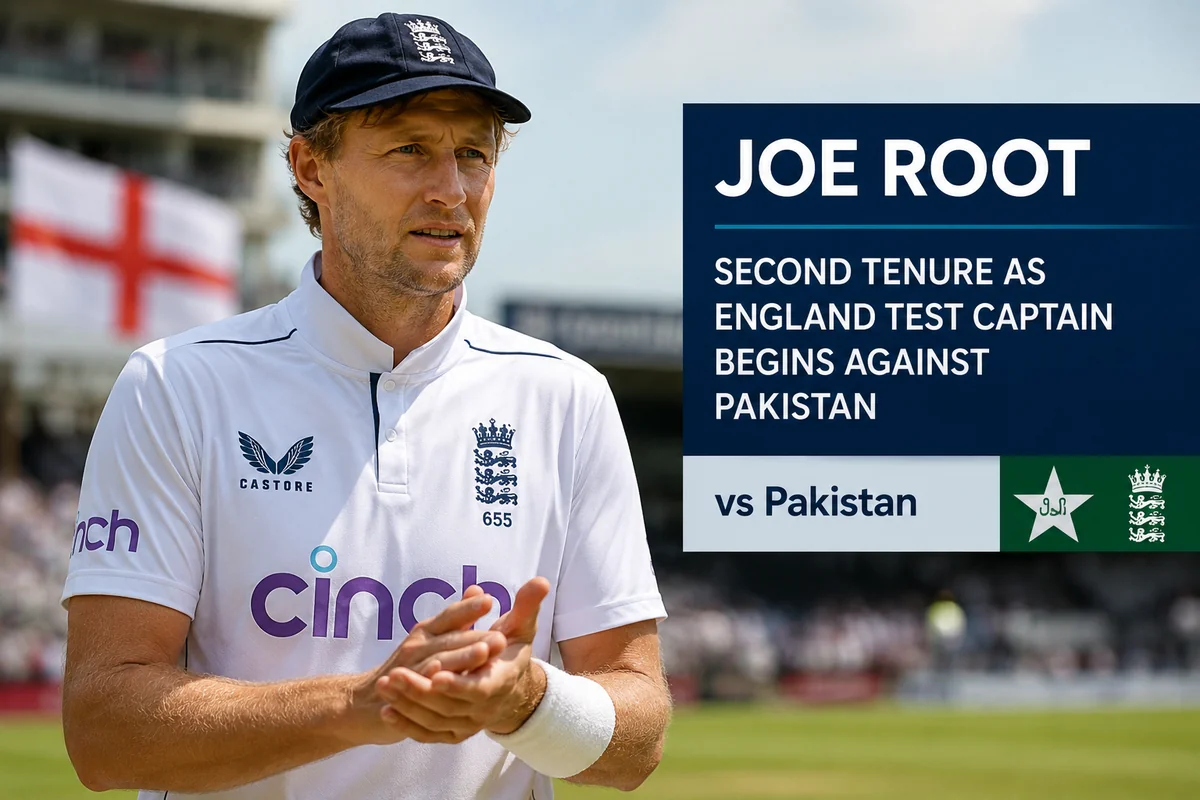
England's summer of Test cricket has been a rolling emergency: a talismanic captain walking away mid-series, a head coach removed weeks after being publicly backed, a curfew introduced and quietly abandoned, and now a centrally contracted fast bowler filmed in handcuffs outside a bar. And yet, with Joe Root in charge and Stephen Fleming on the way, there is a serious case that the wreckage was necessary.
Key takeaways
- Brydon Carse was filmed in police handcuffs outside a Derby bar after a Durham match and released without charge — the latest incident in a chaotic season.
- Ben Stokes retired from Tests mid-series after a disciplinary matter; Brendon McCullum was removed from the red-ball job soon after, both having been backed weeks earlier.
- Joe Root is now full-time captain, working with a head coach currently 11,000 miles away on Zoom.
- England won the first Test against Pakistan by an innings — encouraging, but against desperately weak opposition.
- The genuine improvement is structural: real competition for places and a calmer emotional register around the dressing room.
A season that keeps outrunning the people managing it
The England and Wales Cricket Board have spent this summer in permanent reaction mode, laying track a few metres ahead of a train that will not slow down. The Carse footage is only the newest item on a list nobody at Lord's would have believed in March: a disciplinary process that swallowed the captain, a mid-Test retirement that turned a series defeat into a strange, self-authored farewell, and a head coach dismissed from the format after being told, in public, that his job was safe.
Even the small stuff has had a faintly absurd quality. A team curfew was introduced with some solemnity and then simply evaporated, without ever being formally rescinded. Around the nets, the prevailing facial expression among staff in official training kit has been the wide-eyed one of people who stopped trying to predict the next headline several weeks ago.
This is not the picture of institutional calm that Richard Gould and Rob Key were selling when they conducted their post-Ashes review in the spring. Root captaining full-time while his new coach conducts the relationship by video call from the other side of the planet is, on any reasonable reading, the opposite of the stability that was promised.
Why the first Test result proves less than it looks
The innings win over Pakistan was genuinely enjoyable to watch. The seam attack crackled, the game was over almost before it started, and there were smiles in a dressing room that had not had many of them. It also needs an asterisk the size of a sightscreen.
When the conversation around a touring team turns to whether they are the weakest to visit these shores in a decade or more, the result stops being a reliable measurement instrument. England beat what was put in front of them, quickly and convincingly. Declaring a resurrection on that evidence would be exactly the kind of overreach that got this team into trouble in the first place.
The real change: the team's mood is no longer one man's mood
Stokes was a magnificent cricketer and an inspirational captain who dragged a broken side upwards by force of will. Players loved being in his orbit. But an England dressing room whose emotional temperature was set by a single, volatile individual was always carrying a hidden risk, and the past two years exposed it repeatedly.
The Ashes defeat was the defining example: at 2-0 down, with the series still theoretically alive, England abandoned the aggressive identity that had been their entire argument — and then blinked at Adelaide, on the one surface where that identity might actually have won them a Test. The winter before, in Pakistan, the problem was not just being spun out on fan-dried pitches; it was a squad describing itself as treading on eggshells while the captain's temper ran ahead of him, to the point where an apology followed.
The pattern of the Stokes era was a sequence of enormous highs separated by collapses that nobody could see coming. Root will have bad days as captain too — but the peaks and troughs should be far less violent, and a Test team that plans across five days benefits more from a steady baseline than from occasional genius.
— The case for calmer leadership
Even 2026 began in character: Stokes swearing his devotion to Test cricket, then spending a five-month gap before the format resumed working himself into a state, and unravelling after a single victory. None of that erases what he built. It does explain why the building needed a different occupant.
McCullum, Bazball and the tag that would not come off
Gould and Key could have taken the easy route after the 2-1 defeat to New Zealand in June, writing the whole thing off as collateral damage from the Rex Rooms saga and handing McCullum another cycle. Behind closed doors, though, a phrase had started circulating: "the Ben Stokes show". Once the show's lead had left, the awkward question was whether the production could survive at all.
The conclusion they reached — late, but correctly — was that with Stokes gone the team would never shed the Bazball label while its architect remained. The worst excesses of that era would keep being read into every decision, even as the side genuinely tried to become something more adaptable and more nuanced.
That does not require pretending the project failed. McCullum poured belief into a cricketing culture that is instinctively conservative, and for a group of technically excellent but psychologically exhausted senior players, it was transformative. The limits were also plain: no marquee series win, decisive moments repeatedly not seized, and a striking number of younger players who never quite kicked on in the environment. Root's stated intention to keep the good parts and discard the rest is the right instinct.
Fleming, and the over-correction that isn't coming
The obvious danger in a moment like this is the swing of the pendulum — replacing a maximalist with a minimalist and losing everything worthwhile in the process. Fleming's profile suggests that will not happen. He is a detail-obsessed man-manager with a reputation for tactical flexibility built over years of captaining a New Zealand side that habitually punched above its resources.
The structural bonus is his relationship with McCullum, who remains in charge of the white-ball teams. Split coaching arrangements usually fail on trust and on the perennial fight over players, schedules and physios; two men who actually get on will absorb far more of that friction than an awkward pairing would.
Selection finally has consequences again
The batting order in flux
- Jordan Cox — a controlled, confident 73 at first drop; nominally holding a place, now arguing for one.
- Jacob Bethell — the man Cox is standing in for, currently managing a knee problem.
- Dan Lawrence and Emilio Gay — both pushing to settle a position before the winter.
- Jamie Smith — improving behind the stumps but short of runs, with Cox also able to keep.
- Harry Brook and Root — the only genuinely untouchable names in the top order.
This is the least glamorous improvement and possibly the most important one. Caps are no longer being handed out to favoured players regardless of what the scorecard says, in the name of building a brotherhood. England still pick aggressive cricketers; they simply look less prescriptive about it, and a batter who fails now has someone visible standing behind them.
The bowling carries one obvious structural cost of life without Stokes: with no all-rounder to balance the side, fitting a frontline spinner into the XI becomes very difficult — a hypothetical problem, admittedly, given England do not currently have one demanding selection. In English conditions, though, the four-pronged pace attack is quietly one of the more exciting things about this team, and the re-emergence of Ollie Robinson is the key variable. He still has to prove he can string together a run of Test matches rather than a spell of good days.
And the Stokes question won't go away
Asked in June whether he could ever play under another Test captain, Stokes declined to rule it out — and declined to commit. Watching him bowl fast and bat freely for Durham, visibly unburdened, it is tempting to conclude that what he actually needed was a sabbatical rather than an exit. Given his relationship with Root, a return for next summer's Ashes is not fantasy. Key has already acknowledged, in the careful language of a man dodging a headline, that it would make a hell of a story.
The bottom line
Nothing about the way England arrived here was planned, managed or dignified, and one innings win over a poor Pakistan side settles nothing. But the three things that were genuinely broken — a mood dictated by one man's emotions, a coaching identity the team could no longer escape, and a selection policy that rewarded loyalty over runs — have all been addressed within a single summer. The chaos was real. So is the possibility that it was the price of getting unstuck.